
Microsoft has named Copilot as the number one productivity app in Windows 11.
That puts it ahead of familiar favourites like File Explorer, Microsoft To Do and even the Snipping Tool.
It’s a bold claim, but it highlights something bigger than a simple ranking. AI is rapidly moving from a nice-to-have tool to a central part of the modern workplace.
The question is: does that make Copilot the most important productivity tool for your business?
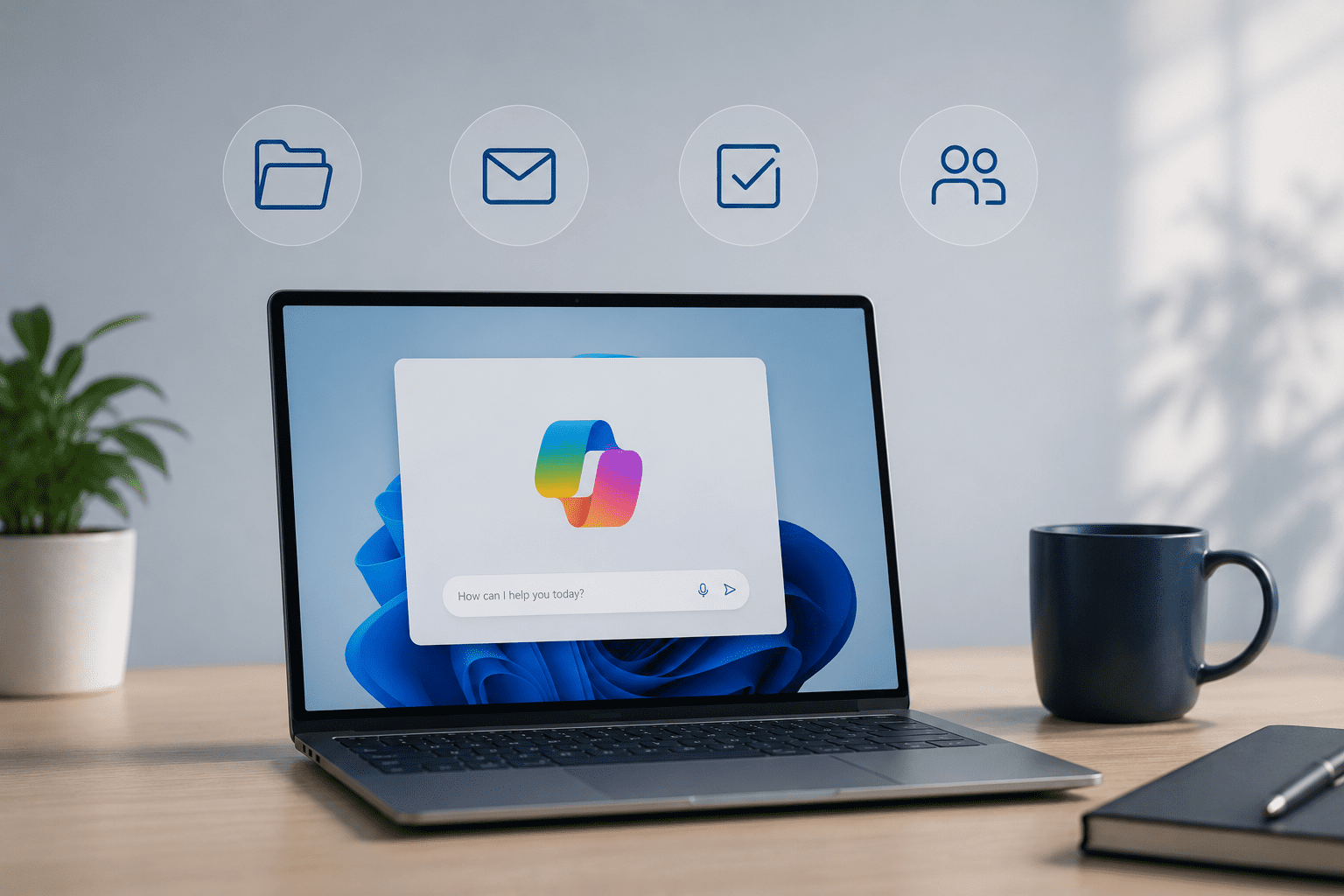
Microsoft’s investment in AI is no secret.
Copilot has been integrated across Windows 11 and Microsoft 365 to help users work more efficiently. It can summarise email threads, draft content, organise information, generate ideas and assist with routine tasks.
For many businesses, those capabilities can deliver real value.
A task that previously took fifteen minutes might take five. Information that once required searching through multiple emails can be surfaced instantly. Administrative work becomes less time-consuming, allowing people to focus on more meaningful tasks.
It’s easy to see why Microsoft sees AI as the future of productivity.
While Copilot is generating attention, most organisations still rely on a different set of tools to keep operations moving.
Think about how often your team accesses documents, searches for files, manages emails, updates tasks or collaborates with colleagues.
These activities are supported by tools like File Explorer, Outlook, Teams, SharePoint and task management platforms.
They’re not particularly exciting, but they’re essential.
If employees can’t find the information they need, if documents are stored inconsistently, or if processes are unclear, productivity suffers regardless of how advanced the AI tools may be.
That’s because productivity isn’t just about working faster. It’s about removing friction from everyday work.
One of the biggest misconceptions about AI is that it replaces existing systems.
In reality, it tends to amplify them.
When processes are well defined and information is organised, AI can help teams move faster and make better use of their time.
When systems are disorganised, AI often exposes those weaknesses rather than solving them.
Businesses that achieve the greatest benefit from AI are typically the ones that already have strong foundations in place. Their systems are reliable, their data is accessible and their workflows are clear.
AI then becomes an accelerator rather than a workaround.
Rather than focusing on which app Microsoft ranks as number one, business leaders should ask a more practical question:
Where is my team losing time?
If staff spend hours summarising information, preparing reports or drafting communications, AI tools like Copilot could provide immediate benefits.
If productivity challenges stem from outdated processes, poor documentation, duplicated effort or disconnected systems, the solution may lie elsewhere.
Understanding the root cause of inefficiency is often more valuable than adopting the latest technology trend.
There’s no doubt that AI will play an increasingly important role in business.
Tools like Copilot have the potential to improve efficiency, reduce administrative workload and help employees focus on higher-value work.
But productivity doesn’t start with AI.
It starts with having the right systems, processes and support in place.
Before asking whether Copilot is the top productivity app in Windows 11, it may be worth asking a simpler question:
Are your current systems helping your team work efficiently, or getting in the way?
Because the best productivity tool isn’t necessarily the newest one.
It’s the one that solves your biggest business challenge.
AI tools like Copilot will continue to evolve and become part of everyday business operations.
But lasting productivity gains don’t come from a single application. They come from having the right people, processes and technology working together.
Technology should help your business operate efficiently, securely and with confidence.
If you’d like to discuss your current environment, future plans or opportunities for improvement, get in touch with the team at Perigon One.