
Artificial intelligence is rapidly becoming part of everyday business.
It drafts emails, summarises meetings, analyses data, recommends actions and automates routine tasks. What once required several manual steps can now happen in seconds.
For many businesses, this feels like a natural step forward. AI improves efficiency, reduces repetitive work and helps teams achieve more in less time.
But as AI becomes more involved in day-to-day operations, there’s an important question every business should be asking.
How much of your business is now being influenced by AI, and do you have visibility over it?
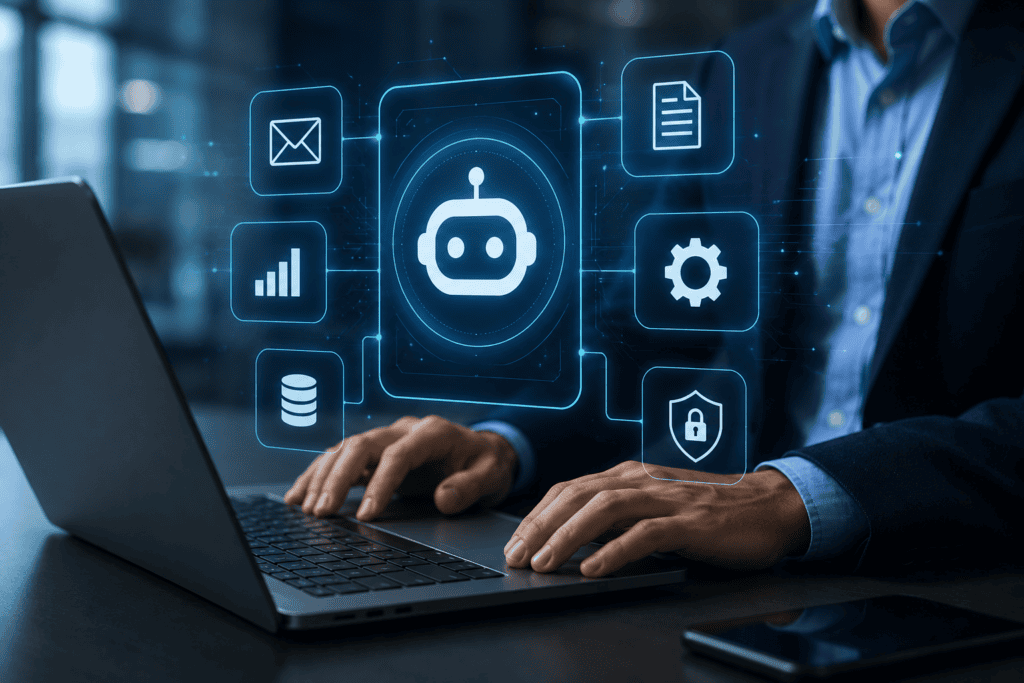
Today’s AI doesn’t simply respond to prompts.
AI agents can connect multiple applications, retrieve information, trigger workflows, update records and complete tasks across different business systems with minimal human involvement.
When implemented well, these capabilities can deliver significant value. Teams work faster, processes become more consistent, and employees can focus on higher-value work.
However, the more responsibility AI takes on, the more important it becomes to understand where it’s operating and what decisions it’s influencing.
Many businesses have a clear understanding of who has access to their systems and data.
Far fewer know where AI has access.
As AI becomes embedded across business applications, it can quietly influence processes that were once entirely managed by people.
Most of the time, everything appears to be working exactly as intended.
But when something unexpected happens, visibility becomes essential.
Can you confidently answer questions like:
If the answer isn’t immediately clear, you’re not alone.
The greatest risk isn’t necessarily that AI makes the wrong decision.
It’s that businesses lose sight of where AI is involved in the first place.
Without clear visibility, investigating customer concerns, responding to compliance requirements or understanding unexpected outcomes becomes much more difficult.
The more AI agents interact with sensitive information and business processes, the more important it is to know what they’re doing, what they’re accessing and what actions they’re authorised to perform.
Good governance isn’t about slowing innovation.
It’s about ensuring your business remains secure, accountable and in control.
AI can support better decisions, but it shouldn’t replace accountability.
When people make decisions, ownership is usually clear.
When AI contributes to those decisions, responsibility can become harder to define unless appropriate governance is already in place.
Businesses should understand:
Putting these guardrails in place allows organisations to embrace AI with confidence while reducing unnecessary security, operational and compliance risks.
AI will continue to evolve, and businesses that adopt it thoughtfully will unlock significant opportunities.
The greatest advantage won’t come from simply using more AI.
It will come from understanding where AI is influencing decisions, maintaining visibility across your business, and ensuring automation always supports accountability.
AI can transform the way your business works, but only if it’s implemented with visibility, security and accountability in mind.
If you’re ready to embrace AI without creating unnecessary risk, Perigon One can help you build a secure, well-governed approach that supports your business today and into the future. Get in touch with our team today to start the conversation.